Let's get in touch
Contact us for more information or a quote.
16 novembre 2020 - Eventi
Hot Foil Stamping: How to Customize Labels with Precious, Shiny Effects
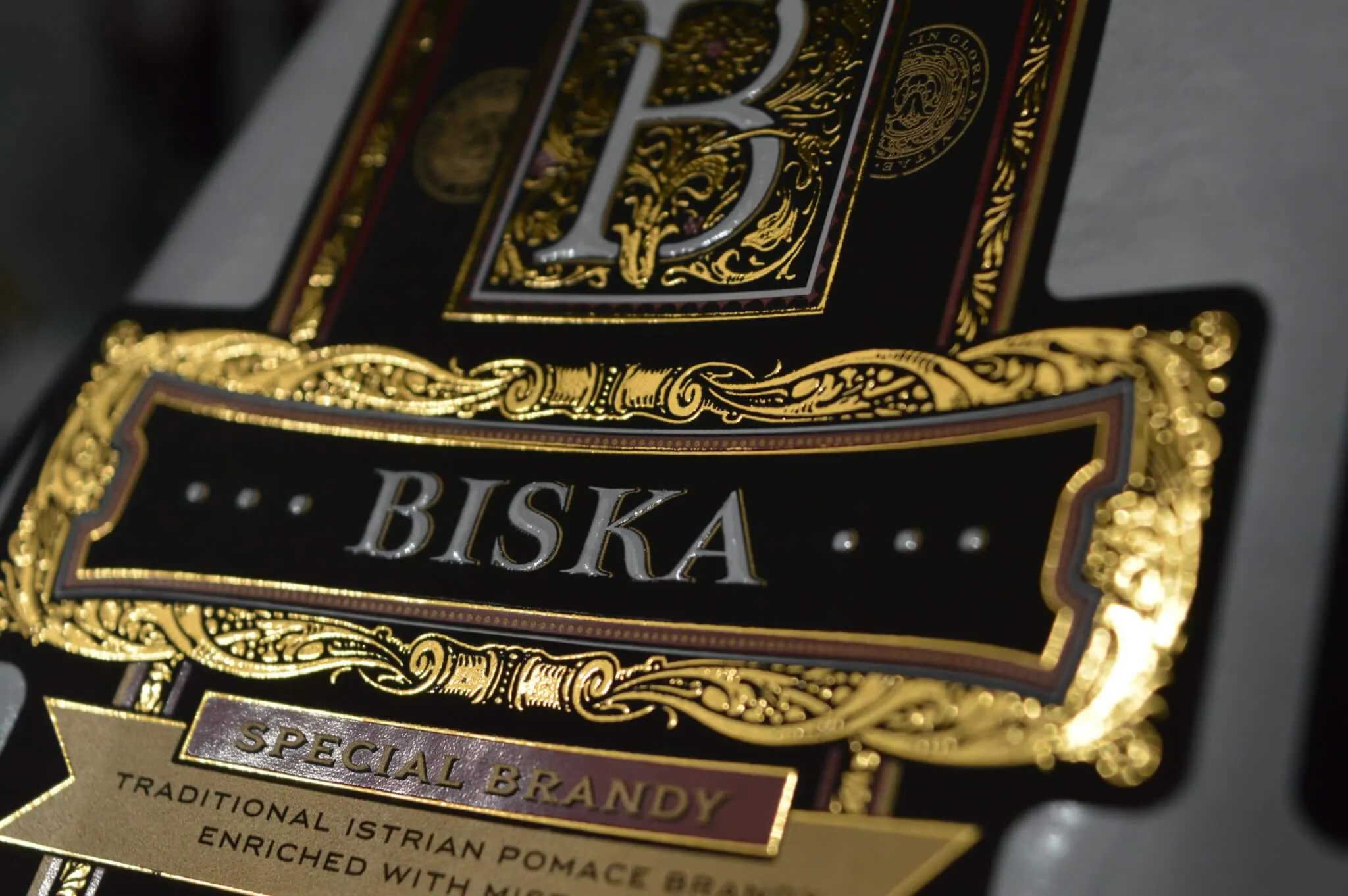
Hot foil stamping is one of the most widely used and appreciated finishing techniques for labels. This process allows for extraordinary results with a relatively simple approach. But what exactly does it involve?
A Brief History
Hot foil stamping officially originated in 1892 in Germany, with the patent filed by Ernest Oeser, aimed at writing on black photo albums. Starting from the 1950s, it became one of the most popular techniques for printing on plastic materials, electrical components, car parts, and cosmetic containers.
Since the late 1970s, hot foil stamping has been the most commonly used method to enhance the packaging of premium and luxury products—but not exclusively.
How It Works

In hot foil stamping, two main elements come into play:
-
The die, or cliché: This can be made of magnesium, zinc, aluminum, or brass.
-
The foil, also called the hot foil or heat-transfer ribbon.
The technique relies on a combination of pressure, heat, and dwell time.
Through these three factors, graphics and text can be transferred onto the printing substrate. The process involves placing the foil between the pre-heated die and the substrate, so that the foil is literally “melted and transferred” onto the desired surface.
The finishes that can be achieved vary depending on the foil chosen. There are metallic foils in a wide range of colors and shades—from gold to silver, copper to bronze, and even pastel tones. Other options include pearlescent, glitter, holographic, and anti-counterfeiting foils. Additionally, the technique can be combined with other embellishments, such as Braille embossing, for an even more sophisticated and refined effect. The result is a touch of class, creativity, and elegance on the label.
Which products are best suited for hot foil stamping?


This technique can be applied to virtually any type of surface, from plastic substrates to natural papers, such as those used in the beverage industry. Wines, spirits, beers, luxury food products, and cosmetics are the main products that lend themselves to labels enhanced with hot foil stamping. It is the ideal choice for those who want labels with shiny effects that catch the eye immediately. Hot foil stamping enhances brand identity and improves the consumer’s perceived quality of the product.
Advantages
The main advantages of hot foil stamping include the availability of a very wide range of materials and colors, the possibility of full-color printing (CMYK), and remarkable water resistance. Moreover, it is probably the only technique that allows the creation of metallic and glossy effects on virtually any substrate: paper, cardboard, plastic, glass, etc.
Disadvantages
Hot foil stamping is certainly not the most economical technique, but it is entirely accessible. Additionally, it is a printing method that is difficult to adapt to very small designs or intricate gradients.
If you want to learn more, here are some of our projects created using hot foil stamping.
If you are looking for premium solutions for your labels to stand out from the competition, please fill out the form below with your details and requirements. We will get back to you promptly for an initial free consultation.
This site is protected by Google reCAPTCHA v3, Privacy Policy and Terms of Service.